

Bibliographic formatting of a completed publication is a mandatory part of every scientific work. Sometimes you have to change the standard in the article to meet the particular journal's requirements.
Different countries and academic disciplines may follow different rules for formatting references. In the message below we discuss the most common international citation styles, explain how they differ, where they are used, and provide some examples.
According to Scopus, the most commonly used styles are Vancouver, CBE, MLA, Harvard, Chicago (Turabian), NLM, and APA.
1. Vancouver Style
This style is used in medicine, biomedical sciences, and pharmacology. In-text citations are indicated there by a number in brackets or as a superior index:
Studies show that vitamin D affects immunity¹.
Sources in the reference list are written in the order they appear in the text.
- Holick MF. Vitamin D deficiency. N Engl J Med. 2007;357(3):266-281.
2. CBE (Council of Biology Editors) Style
This style is essential for biologists, ecologists, and agricultural scientists. It offers three in-text citation substyles:
Name-Year is the most widely used. In-text citations include the author’s last name and the year of publication: (Smith 2020). The reference list is arranged alphabetically:
Smith J. 2020. Photosynthesis in extreme environments. J Plant Biol. 45(2):112–125.
Citation-Sequence: each citation is assigned a number, typically as a superior index, in the order it first appears in the text. The reference list follows the same numerical sequence.
Citation-Name: references are first ordered alphabetically by the author name, however, every name is assigned a number. This number is then used for all in-text citations to that source, regardless of where or how often it appears in the text.
Example: If a work by an author with the name of Smith is assigned number 56 in the reference list, every in-text citation to this source will be ⁵⁶, even if it is cited in the text earlier than some other sources.
3. MLA (Modern Language Association)
This style is common for the humanities: literary studies, linguistics, and cultural studies. In-text citations here put the emphasis on the author and the page number, rather than the year of publication, since in these disciplines, a specific fragment of a literary text is often important.
(Smith 23) — last name and page number.
The list of sources called "Works Cited" is arranged alphabetically.
Smith, John. The Art of Reading. Oxford UP, 2020.
4. Harvard Citation Style (Harvard Referencing)
This style is common in universities in the UK, Australia, and New Zealand, particularly in the social and natural sciences.
Example of an in-text citation: (Johnson, 2019, p. 45) - author, year of publication, page.
The bibliography section is entitled as "References", and references are arranged alphabetically.
Johnson, A. (2019) Climate Change and Society. London: Earth Press.
5. Chicago / Turabian Style (CMOS)
This standard is commonly used in history, art history, and social sciences. Citations here are formatted using one of the two options:
Notes-Bibliography: citations appear as footnotes (at the bottom of the page) or endnotes (at the end of the text). This format provides additional contextual comments without disrupting the flow of the main text.
¹John Smith, The History of Ideas (Chicago: University of Chicago Press, 2018), 72.
Author-Date (similar to the Harvard style), paired with an alphabetically ordered reference list entitled “Bibliography” (and not “References” or “Works Cited”). In-text citations include the author’s last name and the year of publication: (Smith 2018).
6. NLM (National Library of Medicine) Style
This style is used in biomedical journals, especially in the United States. You can see it in the PubMed database. It is very similar to Vancouver style, however, it has more strict formatting rules.
In-text references are formatted with the numbers in brackets or superior indexes:
...has been confirmed in several studies [3].
The reference list is provided in the order of citation.
Smith AB, Jones CD. Gene therapy advances. N Engl J Med. 2021;384(5):450-460.
7. APA (American Psychological Association)
This style is used in psychology, pedagogy, sociology, and business.
In-text citation: (Brown, 2022, p. 105) - author, date, page.
The list of sources is entitled “References”. Citations are listed alphabetically.
Brown, T. (2022). Learning and motivation. New York: Academic Press.
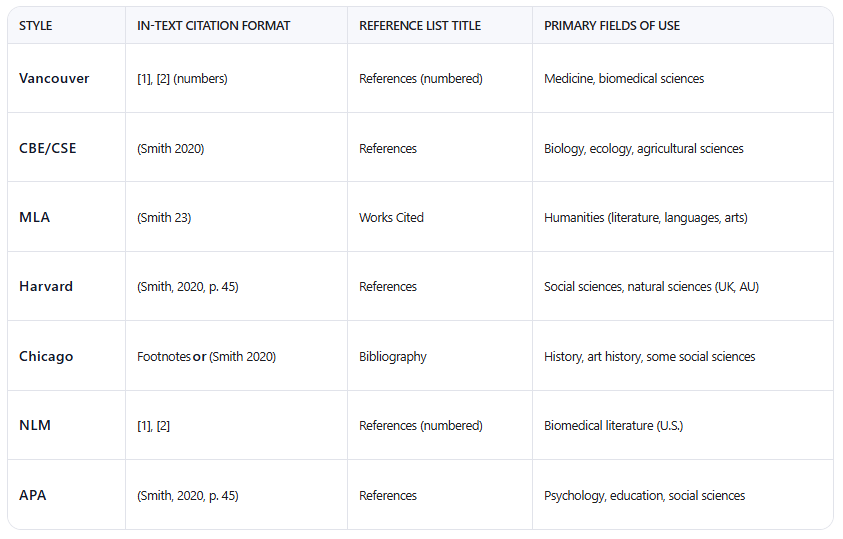
The table below shows the differences in the styles described:
Which style to choose?
Universities and journals often provide their specified requirements in the “Instructions for Authors” section. Typically, journals within the same field share the same citation style:
- Medicine → Vancouver or NLM
- Biology → CBE/CSE
- Humanities → MLA or Chicago
- Social Sciences → APA or Harvard