

When it comes to assessing research impact, citations are usually the first thing that comes to your mind: how many times a paper has been referenced in other publications, whether it is indexed in Scopus or Web of Science. However, modern academia does not only live within scientific databases. It is actively discussed in the media, analyzed in blogs, incorporated into educational resources, cited on Wikipedia, debated on social networks, and it even affects public policy.
All of the above falls under altmetrics (alternative metrics): real-time, digital indicators that track online attention and engagement to the scholarly output. Altmetrics complement conventional bibliometrics rather than replace them: they offer a broader, nuanced view of the research impact, both within and beyond the academic community.
What are altmetrics?
Altmetrics are quantitative and qualitative indicators that show how publications are distributed and discussed in the digital space:
- how often an article is mentioned in social media posts;
- whether it is discussed in the news or in expert reviews;
- whether it is cited in Wikipedia articles;
- how many times it has been saved to reference managers like Mendeley or Zotero (indicating reader interest and scholarly impact);
- whether it is present in academic networks, research forums, policy briefs, government or NGO reports, citations in patents.
Unlike the conventional citation-based metrics, which may take years to accumulate, altmetrics provide almost real-time insights into the reach, resonance, and societal relevance of research. Hence, researchers, institutions, and funding bodies can estimate its impact beyond academia.
Why do we need to know this?
Conventional metrics are effective for assessing academic impact, however, they remain blind to many other dimensions of scholarly work:
- a high-profile study may sway public opinion or inform clinical practice when they get few formal citations;
- educational resources, open datasets, or software may be widely used in teaching but never appear in a scientific journal;
- research published in languages other than English or in national repositories, institutional platforms or minor indexing databases often remains invisible in citation counts, despite their having substantial local or practical impact.
Altmetrics help researchers to:
- identify who is engaging with their work: scientists, journalists, clinicians, educators, policymakers, or the lay audience;
- demonstrate the practical and societal impact of research, when applying for grants or awards where broader relevance is valued;
- monitor trends and discover potential collaborators by seeing where and how research is discussed;
- get an appropriate assessment of scholarly contribution, which is especially important in the humanities, social sciences, and applied fields, where impact often goes beyond journal citations.
Who calculates altmetrics?
Several major platforms collect and arrange online attention data. The most popular are the commercial platforms offering free basic tools and fully open-source solutions.
Please note that Altmetrics are not a universal "rating." They reflect the scope of attention rather than the quality of work. Attention can be both positive and negative, so it is always worth delving into details.
"Donut" and the assessment of attention
One of the most recognizable visualizations is the Altmetric Donut or Altmetric Attention Score. It appears on journal websites, in repositories, and in personal profiles.
The overall weight of the "donut" is the sum of all recorded mentions. The more influential the source, the higher the score.
The colors show the types of attention sources:
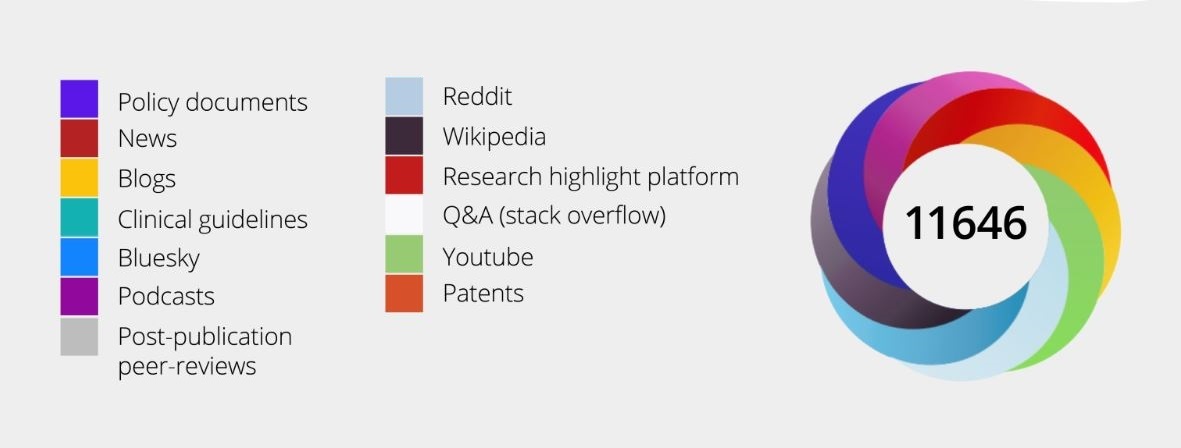
Click on the Altmetric “donut” and see the detailed report of mentions: who shared the paper, when it happened, on which platform, in what context. This is the story of impact: this is where the real value lies, it is not about the score as such.
Please note the Altmetric score may decrease over time, for example, if a tweet or a blog post has been deleted, or spammy mentions have been filtered out by the system. It would be a sign of transparency and data integrity.
How to check the altmetrics?
The easy and free way to get started with altmetrics is to use the Altmetric Bookmarklet, a mini-tool for your browser that shows how your publication is discussed in the media and scientific blogs.
How to install?
- Refer to the official website.
- Fill out the form using an institutional email address (ivanov@itmo.ru).❗Gmail, Yandex, Mail.ru, or any other personal email providers are not accepted.
- Include the “Altmetric It!” to your browser’s bookmarks bar.
Make sure the bookmarks bar is visible (in Chrome: View → Always Show Bookmarks Bar).
The tool works only on the platforms with DOI and properly structured metadata, for example, in Google Scholar, PubMed, or arXiv. It does not work on journal websites that do not have the DOI in the page source code.
The bookmarklet is strictly for personal, non-commercial use.
If you encounter any installation issues, consult the Altmetric Bookmarklet FAQ.
What's next?
Altmetrics are a tool for reflection.
- Why did one study go viral, while another, equally rigorous, remained unnoticed?
- Who is your actual audience: peers, practitioners, policymakers, or the lay audience?
- How can you make scientific knowledge more accessible, practical, and inclusive?
Use altmetrics as a compass rather than a scoreboard: to trace where your work resonates, identify gaps in the outreach, and refine the way you communicate your findings. Science is not just about discovery, it is about dialogue, connection, and shared understanding.