
Imagine you have spent months writing a research paper, and it is suddenly retracted from the journal. Why does this happen and what are the possible consequences? In the message below we will look deeply at this phenomenon.
According to the Association of Science Editors and Publishers (ASEP), retraction of an article from a scientific journal is a mechanism for correcting the information published and notifying readers of data inaccuracies, violations of publication ethics, or plagiarism in the work. They may result from honest misconceptions, typos, or research misconduct. The main purpose of retraction is to warn other authors about the improper use of the results of the article in their research, and to protect the journal reputation.
Retraction of published materials from journals, conference proceedings, and other collections are based on the recommendations and standards of international organizations, primarily the Committee on Publication Ethics (COPE) and the International Committee of Medical Journal Editors (ICMJE).
Reasons for retraction, according to ASEP:
• plagiarism and/or self-plagiarism;
• publication of the same article in several journals;
• manipulation of experimental data or other falsifications;
• incorrect interpretation of research results or other serious errors;
• inadequate list of authors;
• implicit conflict of interest;
• re-publication of an article without the author's consent;
• other violations.
• plagiarism and/or self-plagiarism;
• publication of the same article in several journals;
• manipulation of experimental data or other falsifications;
• incorrect interpretation of research results or other serious errors;
• inadequate list of authors;
• implicit conflict of interest;
• re-publication of an article without the author's consent;
• other violations.
In general, the reasons for retracting articles can fall into three main categories: plagiarism, errors and falsifications, and violations of scientific ethics. More detailed information on the principles of scientific ethics can be found on the ITMO University web-page.
Who can requests retraction:
- The author(s) contact(s) the editorial board of a scientific journal with a request to retract the article, explaining their reasons.
- If the request comes from the reader, the editorial board initiates the investigation, contacts the authors or their institution, receives their explanations and makes a decision on retraction, correction or refusal.
- The editors inform the authors of their decision and obtain their consent for retraction. If the authors ignore the request and the violations tend to harm the reputation of the journal, the editors may retract the article without the authors’ consent, and additionally inform the institution where they work.
For details on the retraction process for a particular journal, please refer to the relevant journal guidelines.
Voluntary retraction
Retractions from a scientific journal are related to serious misconduct or unethical behavior. Authors hesitate to voluntarily retract their articles, as this can lead to condemnation. Meanwhile, science is supposed to be self-correcting.
Those who request the confirmation of an article retracted rarely ask the reason for the retraction. Retractions due to “honest errors” by authors go unnoticed. A recent message in Nature points out that unintentional errors are most often caused by the human factor: incorrect data processing and hence, erroneous interpretation of the results . For example, in medical science, an article discusses early stages of research, which was especially widespread during the COVID-19 pandemic. After collecting additional data, some authors decided to retract their publications.
Where can I find the information about retracted articles?
The most famous project in the field of tracking retracted articles is Retraction Watch. The resource informs the scientific community about ethical violations in publications that result in retraction of articles, including serious errors in methodology, manipulation of data, plagiarism and duplicate publications. The online database currently includes more than 55,000 records and is updated regularly.
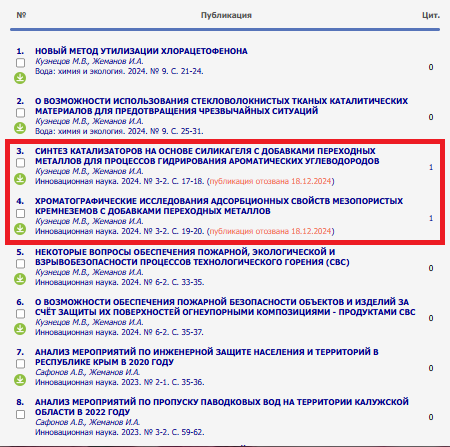
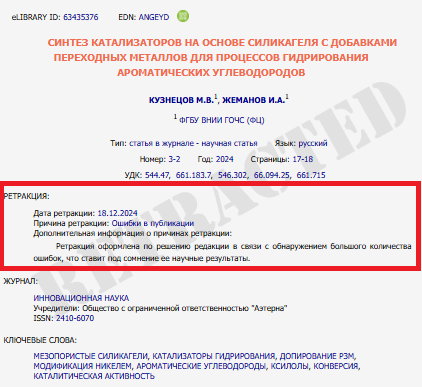
In Russia, the database of retracted publications is available on the website of the Ethics Council of the Russian Academy of Sciences (DB RS ANRI) and in the Scientific Electronic Library eLIBRARY.RU. As of December 2024, the latter contained 5094 records. In the eLIBRARY.RU interface, retracted publications are specifically marked (see the image below) and are not included in the calculation of bibliometric indicators. A retraction mark is also added when generating a reference.
The scale of the phenomenon
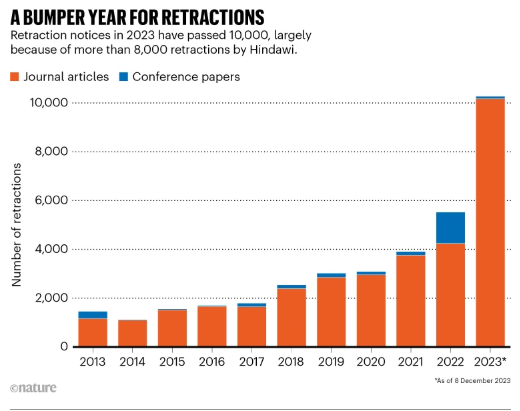
In 2023, 11,884 entries were recorded in the Retraction Watch database. An analytical message in Nature noted that the bulk of the retractions were from journals published by Hindawi, a subsidiary of Wiley. Thus, Hindawi journals retracted more than 8,000 articles in 2023 due to a compromised peer-review process and systematic manipulation of publications. As a result, after a mass retraction, Wiley announced that it would stop using the Hindawi brand, and close 19 scientific journals, and include the remaining 200 in its main portfolio. In 2024, the number of retractions significantly decreased - according to the latest data, there were about 4,150. However, the issue is still relevant.
Conclusion
Article retraction is an important mechanism for maintaining scientific integrity and credibility. It helps identify and correct errors, prevent the dissemination of false information, and protect the reputation of the scientific community. Case studies show that retraction can result from a variety of reasons, from deliberate falsification to incomplete data, however, it always has important consequences.